Symbolic Red: Hermann Nitsch’s 20th Painting Action (3/4)
By Chau Nguyen
Hermann Nitsch, 20th Painting Action, Zuecca Projects, Venice, July 2022
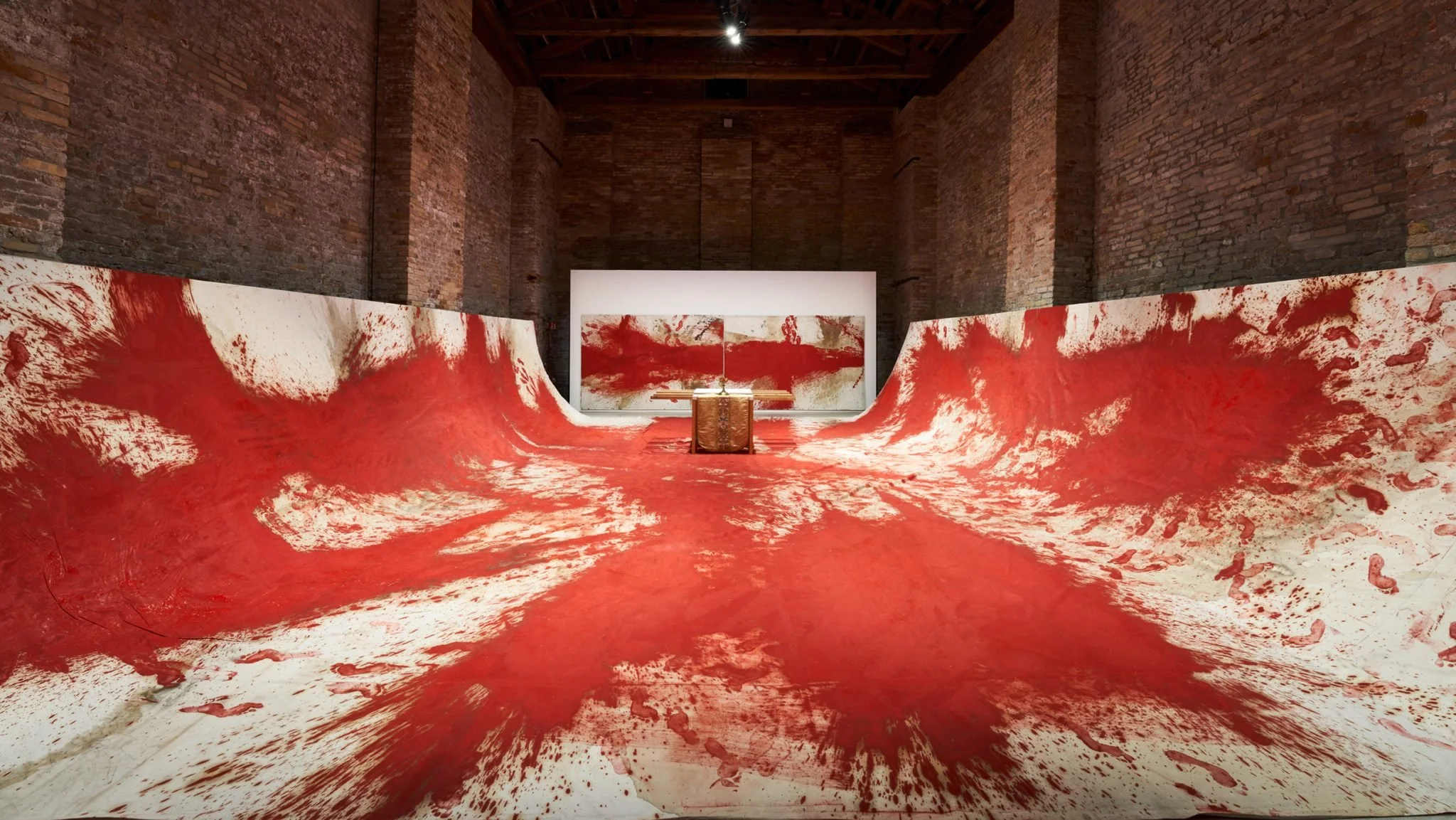
20th Painting Action. Photo courtesy of the Nitsch Foundation.
In Hermann Nitsch’s 20th Painting Action, presented by Zuecca Projects in Venice, a monumental poured painting measuring approximately five by twenty metres occupies the front wall, while a ten-by-ten-metre splatter painting stretches across the floor. Nitsch emerged from Viennese Actionism in the 1960s and developed his Malaktionen, or “painting actions,” alongside performances concerned with sacrifice, ritual, existential excess, and sensory catharsis. The installation offers an interpretation of red as a symbolic color.
This differs from my recent reading of Anish Kapoor, where color operates conceptually as well as materially. Kapoor engages the Western hierarchy that treats color as cosmetic or decorative, while simultaneously overturning it. In Nitsch, by contrast, red does not acquire meaning primarily through its spatial autonomy. The artist uses red as a sign within a larger theater of action.
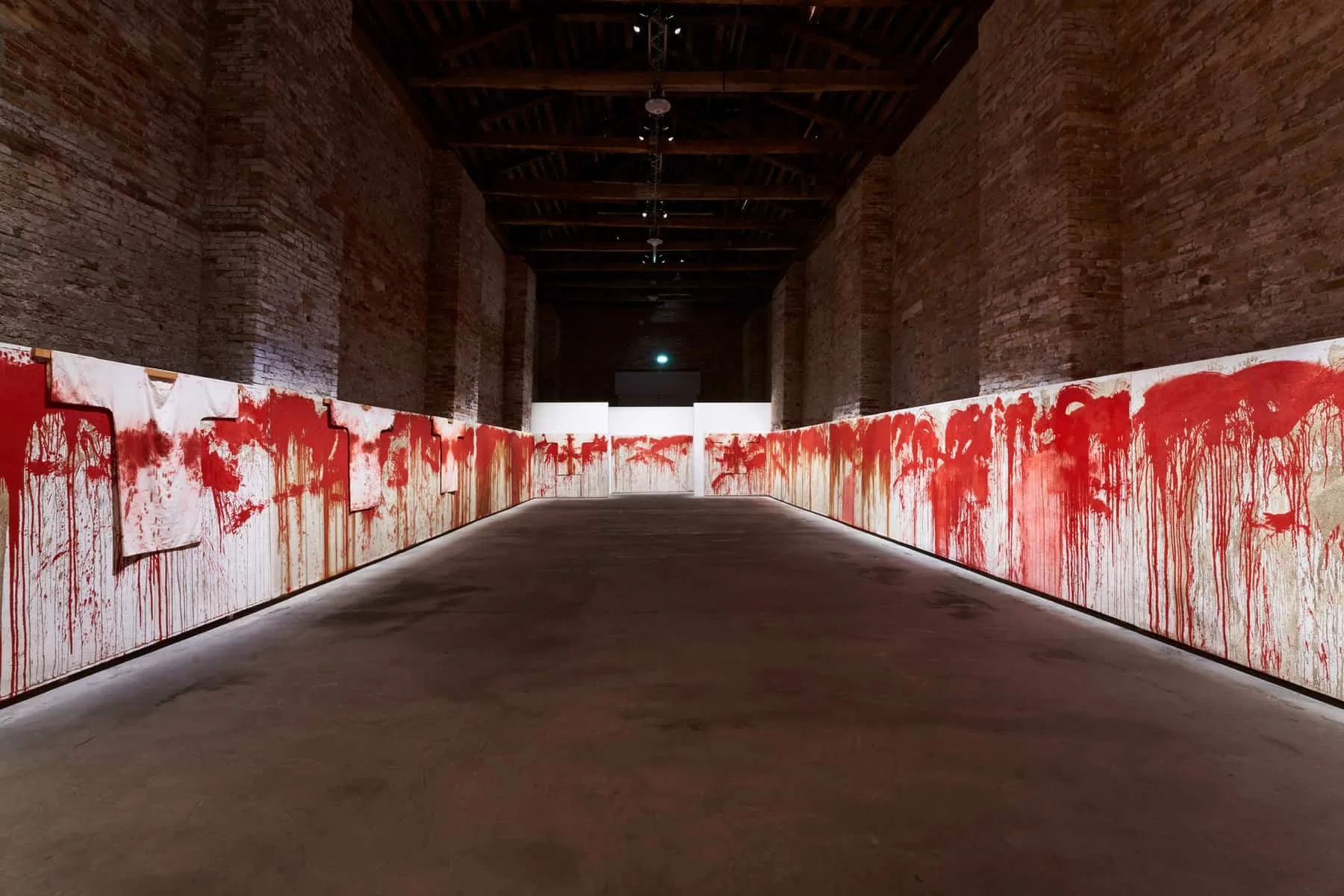
20th Painting Action. Photo courtesy of FAD Magazine.
Despite their appearance of spontaneity, the paintings in 20th Painting Action reveal a surprisingly calculated organization of gesture. Vertical streams descend at measured intervals; horizontal movements expand across surfaces; repeated splashes establish visual rhythms within the installation. The gestures sometimes recall Cy Twombly, but without Twombly’s graphic decisiveness. Nitsch’s marks instead operate almost architecturally. Their direction and scale expand or contract the surrounding space, making the viewer conscious not simply of individual canvases but of the physical environment containing them.
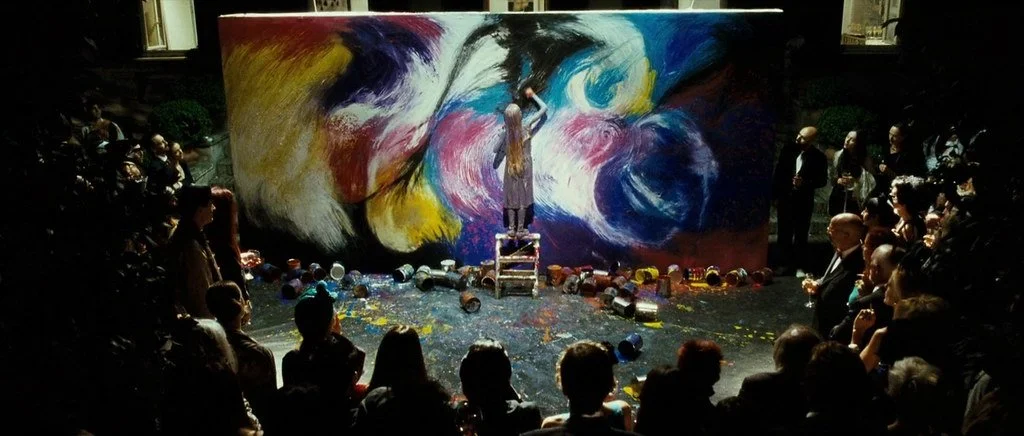
The Great Beauty (La grande bellezza), Dir. Paolo Sorrentino, 2013.
This distinction recalls a scene from Paolo Sorrentino’s The Great Beauty (La grande bellezza, 2013), in which a young girl performs a painting before an audience. The significance of the scene lies less in the particular colours the girl uses than in her embodiment of painting as an event. When the painter becomes immersed in paint, life temporarily becomes art.
Nitsch operates through a similar collapse between artwork and action. The shirts incorporated into his installations suggest absent bodies, ritual garments, and sacrificial traces. Paint records where bodies have moved. The canvas becomes less an autonomous image than evidence that an action has occurred. Red therefore functions as a symbolic base upon which gesture becomes visible. Nitsch’s theatrical system, rather than colour alone, activates red's associations.
Nitsch’s painting actions can also be read alongside Carolee Schneemann’s use of the body as a medium in works such as Up to and Including Her Limits (1973–76). For Schneemann, paint becomes the residue of bodily movement. The marks register the artist’s physical trajectory through space. Nitsch’s gestures, by contrast, remain embedded in a ritual vocabulary in which red signifies blood, violence, sacrifice, and purification. Schneemann thus makes bodily action a means of asserting presence and authorship, while Nitsch turns bodily action into symbolic ritual. The distinction is important: in both practices, painting becomes inseparable from the body, but for Schneemann the body produces meaning, whereas for Nitsch the body activates an already established symbolic language.
In 20th Painting Action, colour does not merely express life. It provides the symbolic ground upon which the proposition that art becomes life can be performed.