To Ngoc Van: Red as a Social Signifier
By Chau Nguyen (4/4)
I return to To Ngoc Van in the context of the recent attention surrounding the rise of Vietnamese modern art at international auctions in 2026. After the creation of his painting titled Thieu Nu Ben Hoa Hue (Young Woman with Lilies), widely regarded as one of the most iconic paintings in Vietnam, To Ngoc Van became a foundational figure in Vietnamese Modernism. His paintings continue to occupy an important place within Vietnam’s art community and in collections abroad. His significance is further reflected in the sustained institutional study and scholarship surrounding his career in Vietnam. In September 2026, Vietnamese General Secretary and President To Lam visited the exhibition accompanying the inaugural To Ngoc Van Award, reflecting continued official recognition of the artist and his place within Vietnam’s cultural history (Tran).
The artist’s use of red is considered within the broader context of red’s centrality to Vietnam’s visual identity, most visibly in the national flag, where a bright red field is marked by a single yellow star, as well as in the broader national color palette. In this respect, Vietnam shares a visual affinity with China, where red has likewise become deeply embedded in national and cultural identity. Beyond its political associations, red occupies a significant place in Vietnamese clothing and cultural life as a color of celebration, prosperity, and good fortune. It frequently appears in ceremonial dress, particularly during weddings, Lunar New Year, and other festive occasions, where its brightness conveys joy and auspiciousness. Red is also prominent in traditional decorative practices, temple spaces, and religious offerings, linking the color to both everyday celebration and spiritual life. Its recurrence across these contexts gives red a distinctly affirmative and communal quality. It is not simply a political color, but one associated with happiness, vitality, and collective identity. As a national color, red therefore operates across multiple registers in Vietnam, moving between cultural tradition, ceremonial life, and modern political symbolism. Across these symbolic registers, the red that recurs in To Ngoc Van paintings is a vivid vermilion, deployed strategically as a social and cultural signifier.
The scarcity of red in his paintings is especially striking when considered against the work of contemporaries such as Nguyen Gia Tri, whose lacquer paintings frequently harness the possibilities of vermilion. For Gia Tri, red becomes an expansive, sensuous field—a color with its own visual and material presence. In To Ngoc Van, by contrast, red is often localized. It points outward, carrying political, social, and emotional associations. In works made during his years in Hanoi, the color can consequently be read as a signifier of political allegiance and the Communist Party.
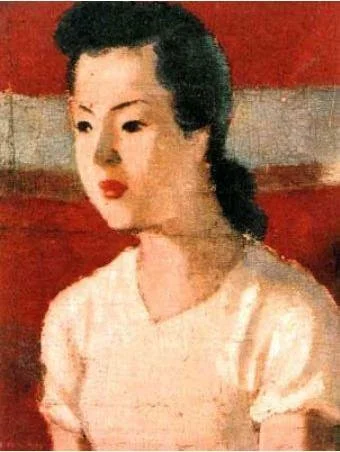
Portrait of a Woman by To Ngoc Van. Image courtesy of Lang Xuan Cau.
To Ngoc Van’s paintings are notably restrained in their use of red in his portraits and figurative compositions. When red does appear, it tends to occupy a specific and highly charged area of the composition, a flag, a garment, or a woman’s lipstick, where it functions less as decoration than as a signifier. In Portrait of a Woman, red appears prominently in the woman’s lipstick and in the background. The lipstick functions as a signifier of femininity, linking cosmetics to the construction of female identity and youth. Yet the red of the background is more visually dominant than the lipstick, suggesting that national identity exceeds the identity of the individual. Her femininity is consequently absorbed into a larger ideological field.
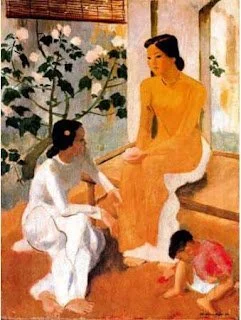
Two Women and Child (1944) by To Ngoc Van. Image courtesy of Lang Xuan Cau.
To Ngoc Van’s use of red can also be assessed in relation to Western modernist approaches to color. While Western modernists often treated color as an autonomous formal or expressive element, his use of red remains closely tied to Vietnamese cultural and social meaning, carrying associations with national identity, gender, prosperity, and political history. In Two Women and Child (1944), the child’s clothing combines red and pink, introducing red as a national symbol associated with prosperity and good fortune. The color can also signal the social importance of the male subject within the family and, by extension, within society. Concurrently, red is integrated into the painting’s analogous color scheme, which encompasses apricot, sepia, and other earthy tones. This chromatic unity evokes a sense of warmth, affluence, and familial stability while also suggesting an idealized vision of the prosperous family. The color palette operates not only as a formal device but as a means through which national identity, gender, social values, and ideology become visually interconnected.
This approach to oil painting also reflects a sustained engagement with European traditions of representation. Johannes Vermeer’s Girl with a Red Hat offers a useful comparison with To Ngoc Van’s treatment of red. In Vermeer’s painting, the hat’s vermilion is constructed through layered glazing, with successive applications of transparent pigment producing depth and luminosity. The red hat also draws attention to the sitter’s presence and individuality, functioning as a vivid marker of her identity within the composition. Red therefore operates simultaneously as a formal and representational device. To Ngoc Van similarly concentrated red in singular elements—such as clothing, lipstick, and other details—using isolated areas of color to draw attention to particular aspects of the figure. Yet while Vermeer’s red primarily operates through the formal and perceptual qualities of paint, the artist’s use of red carries additional cultural and social associations.
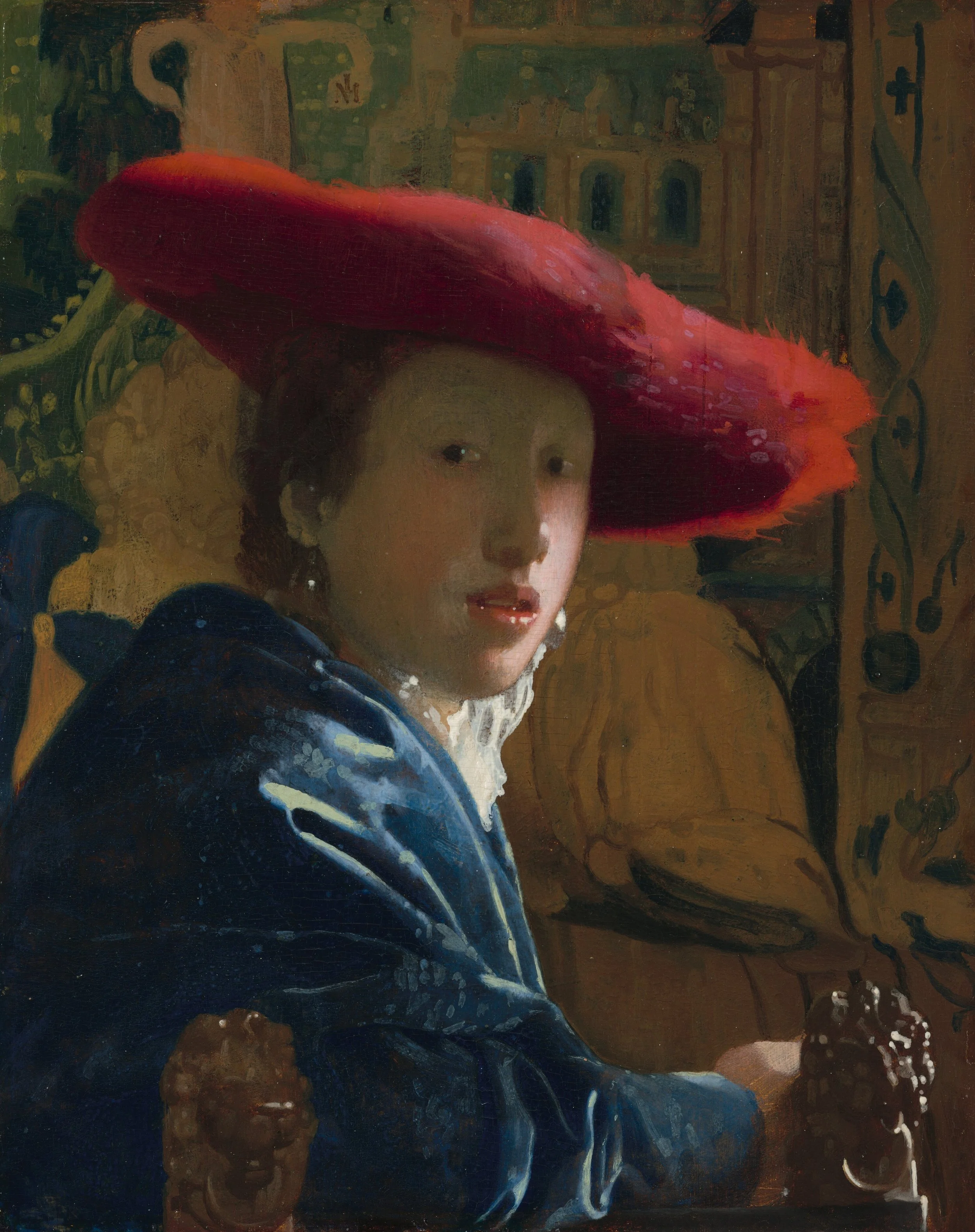
Girl with a Red Hat by Johannes Vemeer. Image courtesy of The National Gallery of Art.
Although To Ngoc Van worked within the academic tradition established by Victor Tardieu at the École des Beaux-Arts de l’Indochine, he developed a more intimate approach to the representation of women. His compositions retain classical structure, tonal relationships, attention to color temperature, and deliberate cropping, but these devices are often used to construct spaces centered on women’s everyday presence. Rather than presenting the female figure within a generalized academic setting, he frequently crops the composition closely around domestic interiors, clothing, gestures, and interpersonal relationships, creating a pictorial space associated specifically with women’s lives. These spaces give his figures greater visual and social specificity, while the selective use of red in clothing, lipstick, and other details situates individual identity within broader associations of femininity, prosperity, social status, and Vietnamese cultural identity. His synthesis of academic structure with the chromatic sensibilities of Impressionism and Post-Impressionism thus allows color and composition to operate simultaneously as formal and social devices. In this sense, To Ngoc Van demonstrated how French academic training could be transformed into a distinctly Vietnamese modernist language in which color carries both formal and cultural meaning.
The occasional appearance of red in To Ngoc Van’s paintings can be understood as part of his negotiation of oil painting as a medium that came to define his career, as well as his position within Hanoi’s elite cultural circles. French influence remains visible in his treatment of light, particularly in the luminous drapery surrounding his figures, yet his engagement with Modernism and recurring attention to women, feminine interiors, and emotional landscapes point toward a more intimate visual language. Red consequently operates on multiple levels: as a formal element within his modernist vocabulary and as a cultural signifier shaped by Vietnam’s social and political history.
References
“Họa sĩ Tô Ngọc Vân (1906–1954) – Tác phẩm.” Làng Xuân Cầu, 3 June 2011.
Trần, Thắng. “Tổng Bí thư, Chủ tịch nước Tô Lâm tham quan triển lãm Đồng hành cùng Giải thưởng Tô Ngọc Vân.” Tạp chí Mỹ thuật, 18 Sept. 2026.