Conceptual Red: Anish Kapoor at the Hayward Gallery (2/4)
By Chau Nguyen
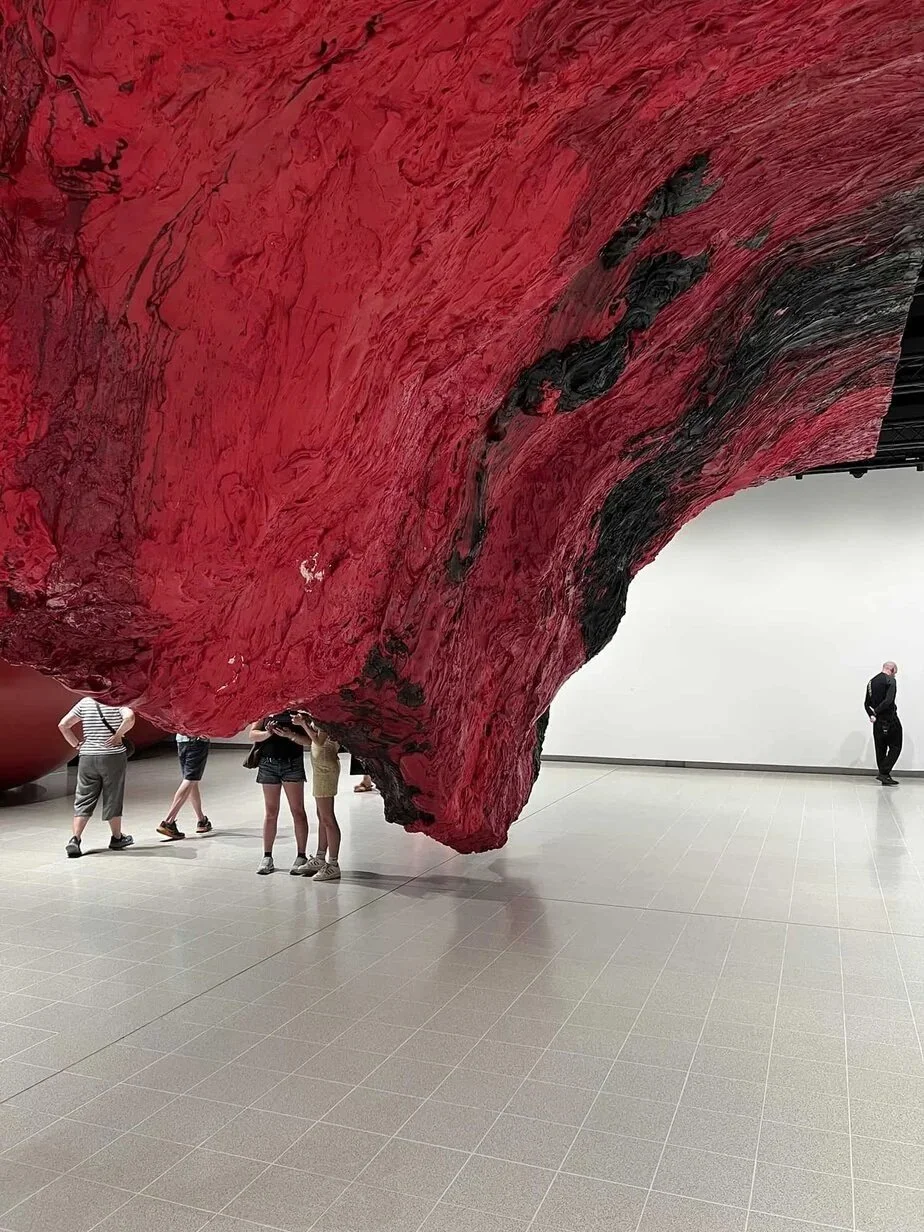
Anish Kapoor at the Hayward Gallery, London. Photography by Jitesh Pastel Illustration.
Anish Kapoor, Hayward Gallery, London, UK, 16 June–18 October 2026
In Anish Kapoor’s retrospective at the Hayward Gallery, red operates as an ideology. Kapoor turns red into a visceral condition through which the viewer encounters questions of matter, power, violence, sacrifice, and the divine.
The exhibition, curated by Ralph Rugoff, brings together four decades of Kapoor’s work, including mirrored steel sculptures, Vantablack works, voids, paintings, and large-scale installations. Among them is Ha Makom (2026), a monumental, cavernous installation of pigment and mixed materials. The title, Hebrew for “the place,” also invokes the Kabbalistic association between place and divinity.
Color psychology provides an entry point into Kapoor’s use of red. Red is commonly associated with danger, excitement, aggression, passion, power, and dominance. In the 2004 Athens Olympics study, athletes in four combat sports: Boxing, Greco-Roman wrestling, freestyle wrestling, and taekwondo, were randomly assigned red or blue clothing. The study reported that competitors wearing red won more contests, and that red might have influenced perceptions of dominance. The example reveals the physiological meaning in the color. Red, as a marker of aggression, is also fundamental to the Hayward exhibition.
Kapoor’s coming to terms with red is palpable at Hayward. Red seeps into it, coating, staining, and saturating its surfaces, fueling an immersive viewing experience into the metaphysical landscape. Ha Makom is exemplary of this intention. The work therefore stages a peculiar reversal: The color that traditionally belongs to the surface becomes a means of entering the interior. Crimson pigment infuses Kapoor’s recurring caves, holes, portals, and voids, turning them into optical teases.
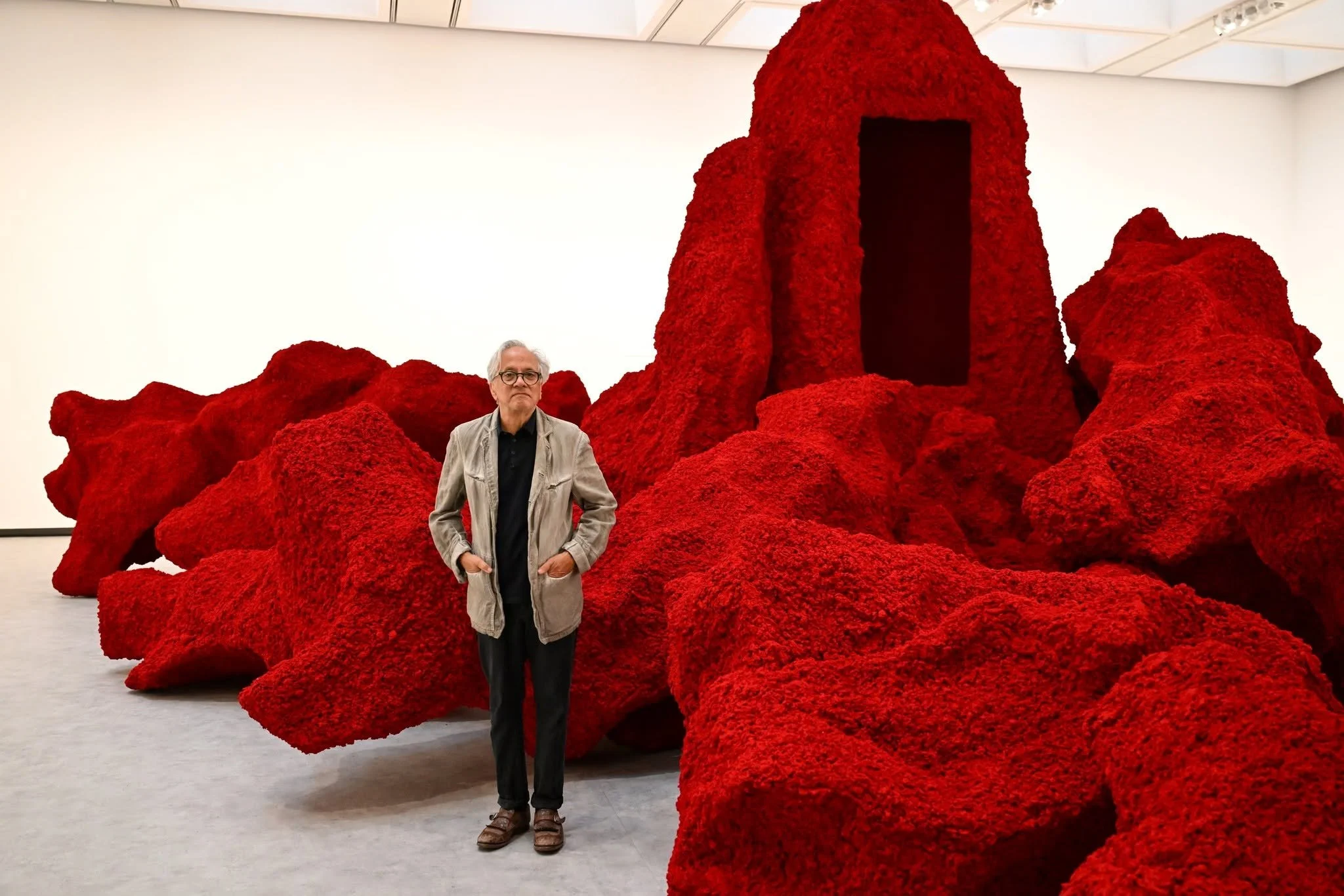
Anish Kapoor poses with Ha Makom, 2026, at an exhibition of his work at the Hayward Gallery in London. Photograph: Nicky J Sims/Getty Images
The red in Ha Makom exists alongside a more explicit corporeal vocabulary elsewhere in the exhibition. Ritual Expiation (2025–26), for example, consists of floor-based works that evoke piles of viscera or the remains of a sacrificial ritual. The Hayward describes the series in terms of a ritual or gory aftermath.
David Batchelor's Chromophobia argues that Western culture has repeatedly relegated color to the realm of the superficial, the supplementary and the “cosmetic,” while associating color with bodies and categories positioned as other to supposedly rational, structural forms of culture. Kapoor engages with this hierarchy while overturning it: his red is cosmetic, yet its monumental scale makes color structural, shaping the viewer’s spatial and bodily experience. Enveloped in red pigment, his mountain becomes anatomy; the cavern becomes wound; pigment becomes blood. Here, the color effect produces the meaning of the form and gives it a conceptual charge.
In Kapoor, scale also matters. A small object resembling blood can be uncanny. A monumental environment covered in red changes the viewer's physical relationship to the image. In Kapoor’s image, gore becomes architecture. The artist turns Batchelor’s idea of cosmetics into a structural landscape.
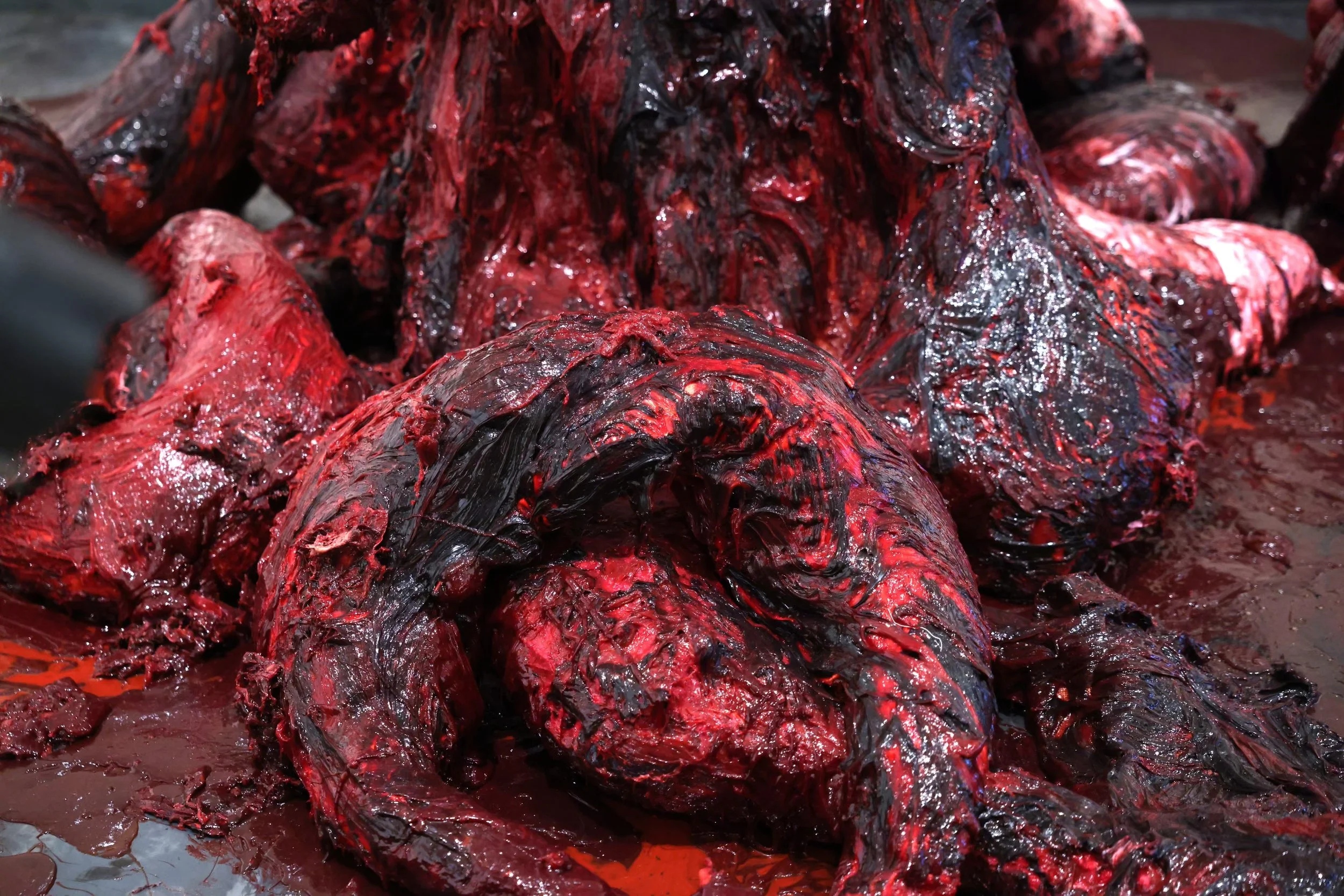
Ritual Expiation by Anish Kapoor, Hayward Gallery, London. Photograph: Neil Hall/EPA
This is particularly striking in relation to the different kinds of red circulating through Kapoor's practice: industrial-looking reds, lacquer-like surfaces, enamel-like coatings, dense acrylic or oil-like passages, powdered pigment, and materials that imitate blood. Their differences matter because they prevent red from becoming a single stable substance. In Kapoor, red is an unstable category masquerading as a singular one.
The effect is extreme enough to implicate popular visual culture. Kapoor's gore does not belong exclusively to the history of sculpture or religious painting. It also participates in a contemporary visual economy saturated with cinematic violence, horror, special effects, and the aesthetics of bodily destruction. One might think of the blood-slick theatricality of Pulp Fiction, or the visceral grotesquerie associated with writers such as Chuck Palahniuk. These references need not be understood as direct sources. Rather, they identify the cultural environment in which contemporary viewers encounter artificial blood, mutilated bodies, and spectacular violence as familiar visual languages.
Moreover, Kapoor's work in the exhibition features bifurcations. Bifurcations can be understood philosophically as a division into two branches: body and spirit, real and imagined, sacred and profane. In Kapoor’s work, these divisions are rarely stable. The resulting forms can suggest altered perception, interiority, and a separation between the physical world and an imagined elsewhere. This instability also recalls the visual language of psychedelic and narcotic imagery, in which doubled, split, or branching forms have historically been used to evoke altered states of consciousness. Bifurcation, in this sense, becomes associated with drugs as a visual metaphor for perceptual fragmentation, hallucination, and the experience of inhabiting two realities at once. This reading of bifurcation also resonates with the American popular culture in which the artist came of age, from Chuck Palahniuk’s visceral fiction to the gore aesthetics of Pulp Fiction, further intensifying the exhibition’s engagement with violence, flesh, and bodily excess.
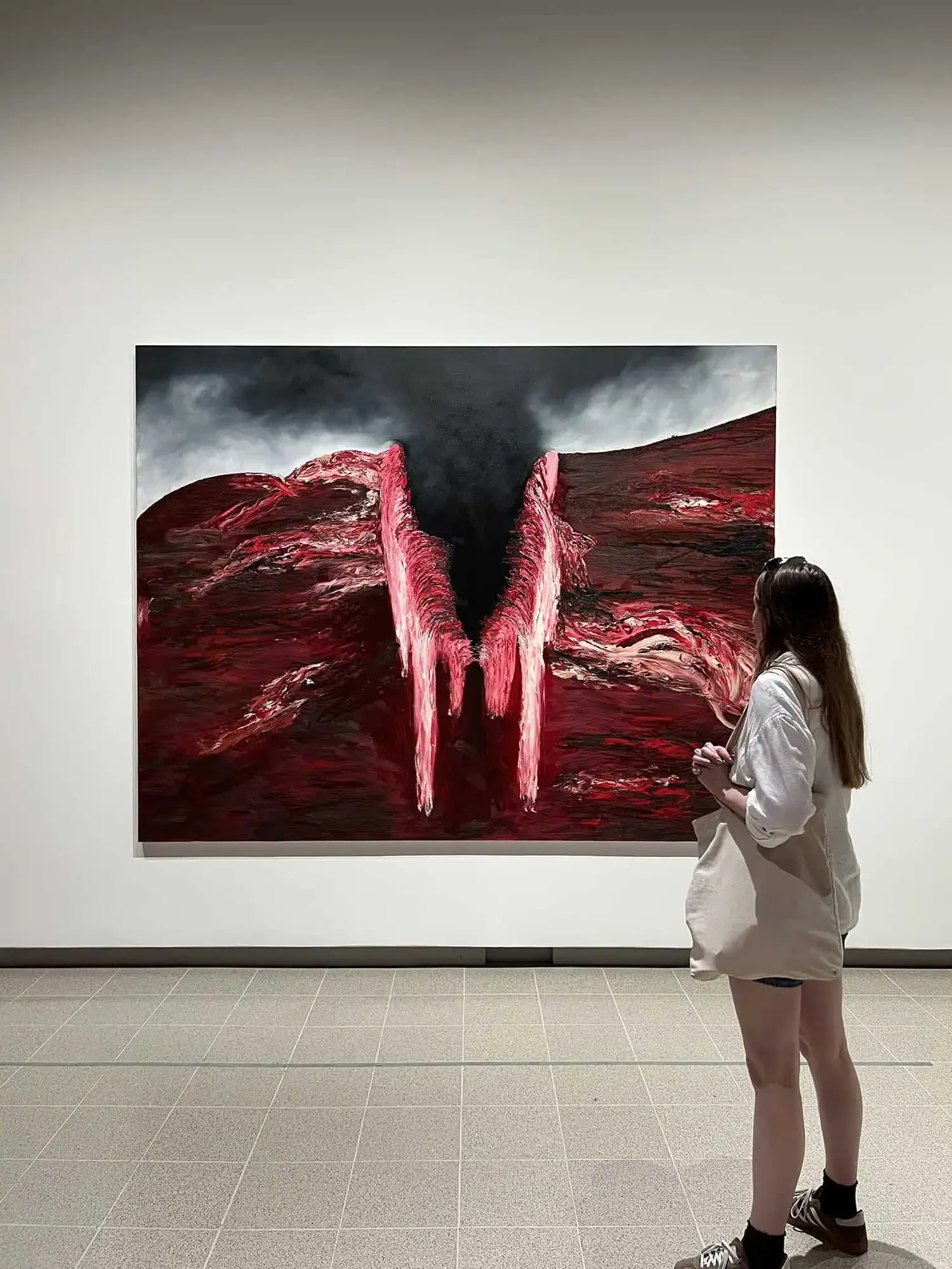
Visitors pause to admire one of Anish Kapoor’s striking red paintings. Photograph by Jitesh Pastel Illustration.
What makes the Hayward retrospective compelling is ultimately not the fact that Kapoor uses a great deal of red. In Kapoor, red finally means something more ambitious: An idea attempting to become matter.
Lastly, the religious dimension of the exhibition is difficult to ignore. Ha Makom explicitly introduces a theological vocabulary. Kapoor has connected its title to the Kabbalistic relationship between place and deity, while the work itself stages a dark aperture within an immense red landscape. Elsewhere, Ritual Expiation invokes sacrifice, bodily remains, and ritual violence. The exhibition therefore repeatedly approaches the territory of religious image-making without settling comfortably into religious representation.
The dark aperture within Ha Makom is therefore not simply a hole. It is a conceptual hinge. The red exterior appears intensely material, while the black opening suggests an immaterial elsewhere. This is also where the exhibition's optical games become more than perceptual tricks. Kapoor's voids and portals destabilize the viewer's confidence in what constitutes an object. The question becomes less “What am I looking at?” than “Where does it begin?”
This raises a more interesting question than whether Kapoor's work is “religious.” What makes an artwork religious in the first place? Kapoor's work has always been unusually invested in this threshold. The divine, in this context, does not necessarily appear as an image of God. It is conveyed in the artist’s continuous references to the origin of his conceptual ideas, which exists outside of the scope of the exhibition.
References
Batchelor, David. Chromophobia. Reaktion Books, 2000.
Hill, Russell A., and Robert A. Barton. “Red Enhances Human Performance in Contests.” Nature, vol. 435, 2005, p. 293. Nature, https://doi.org/10.1038/435293a.