Henri Rousseau Deserves More Than Our Condescension (Artnet)
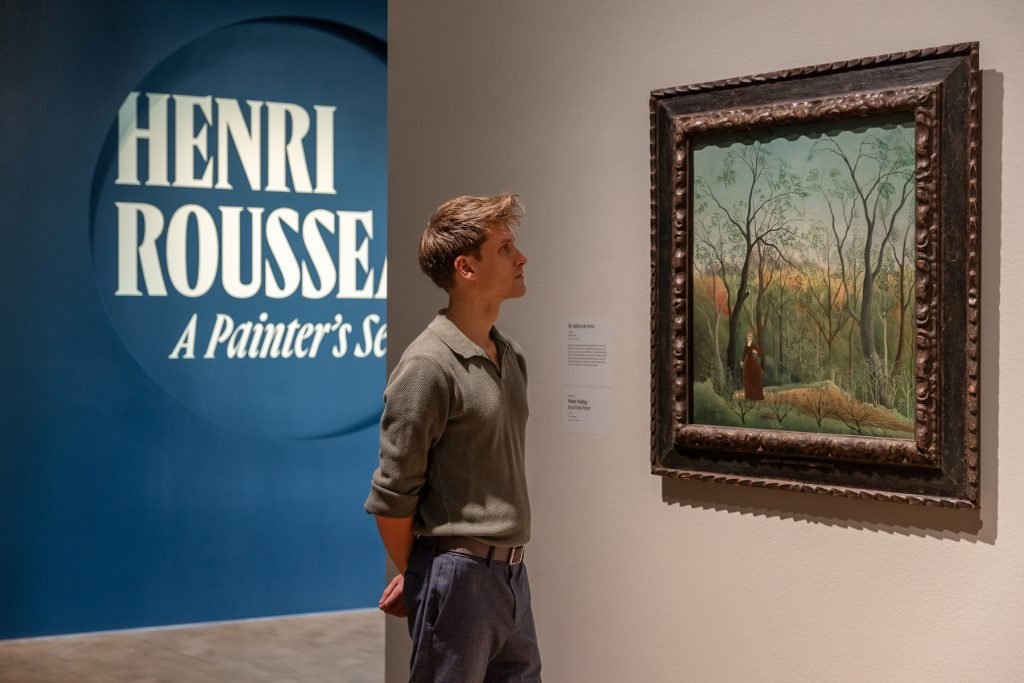
"Henri Rousseau: A Painter's Secrets," 2025. The Barnes Foundation, installation view. Image courtesy Barnes Foundation.
December 27, 2025
Excerpts:
The Barnes Foundation has leveraged its possession of Henri Rousseau’s iconic Unpleasant Surprise (1899–1901) and Scouts Attacked by a Tiger (1904) to orchestrate a cohesive survey of the artist’s oeuvre. The exhibition, “Henri Rousseau: A Painter’s Secrets,” co-curated by Nancy Ireson, the Deputy Director for Collections and Exhibitions at the Barnes Foundation, and Christopher Green, a consulting curator and Professor Emeritus at the Courtauld Institute of Art, convenes roughly sixty additional works.
Overall, the exhibition reads as a lukewarm induction of Henri Rousseau into the proverbial boys club, a belated embrace of an artist whose market value and critical esteem escalated only posthumously. His work nonetheless asserts itself with striking clarity.
In the public eye, it is difficult to envision an exhibition of Vincent Van Gogh fixated on his financial struggles to the exclusion of the content and form of the paintings. Rousseau may not occupy the same rank as Van Gogh in the history of art, but his strongest works are similarly arresting in their decisive formal gestures. His explicit defiance of academic norms justifies in part why a young Picasso gravitated toward him, and why Kandinsky later marveled at his originality. Yet this is rarely mentioned at the Barnes. Rather, the contemporary art establishment seems intent on a postmortem dissection of the artist’s corpus, articulated through a chronicle of critics’ cynical viewpoints on both Primitivism and Rousseau.
In the exhibition, Rousseau has the last laugh. The show is worth visiting not for the often side-eyed insights provided by the curators, but for the sheer breadth of the work and its mesmerizing legacy. Absent from the commentary is a sustained engagement with the emotional impact and visual authority of some of his best works.
Go to see Rousseau for his depictions of stylized plants imbued with a primal force in paintings such as Woman Walking in an Exotic Forest (1910) and Black Man Attacked by a Jaguar (1910). He toiled with meticulous discipline, assembling his best paintings the way a fine writer constructs a book. His stylistic compositions contain myriad narratives—secrets untold in the exhibition notes. His painstaking approach negates the lack of a formal art education, revealing a vigilant, observant mind. This perspective evolves in Rousseau’s landscapes. In The Chair Factory at Alfortville (c. 1897), House on Outskirts of Paris (1902), and Walkers in a Park (1908), miniature human figures roam vast terrains, a subtle critique of France’s expanding industrial power, while gesturing to larger natural forces in the background.
The cinematic component in Rousseau’s work, emphatically ahead of its time, comes alive in the last section of the exhibit in three ambitious, almost futuristic pieces: The Sleeping Gypsy (1897), Unpleasant Surprise (1899–1901), and The Snake Charmer (1907), displayed here together for the first time. In these paintings, the artist leans into deep shadows, sculpted volumes, and dreamy nocturnal atmospheres, inviting reflection and interpretation.