From Tilted Arc to Running Arcs: Richard Serra, Art Laws, and Legacy
By Chau Nguyen* and Eric Orts**
March 2026
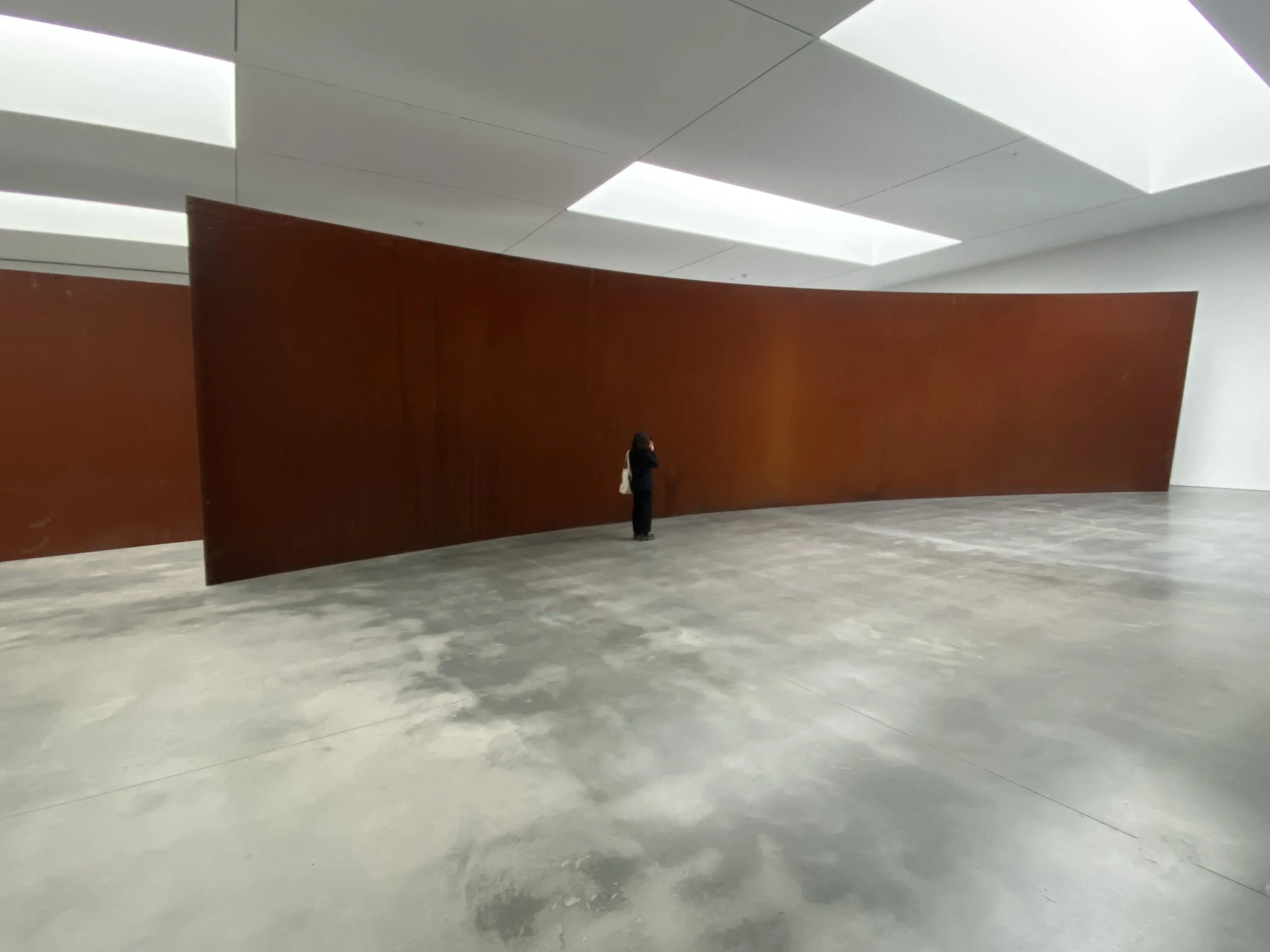
The Gagosian, photo by Eric Orts
Running Arcs (for John Cage) (1992), previously on view at the Gagosian in New York in 2025, reads not only as a posthumous tribute to Richard Serra but also as a structural response to the political and legal history of his Tilted Arc (1981-1989). Running Arcs, which consists of three identical rusted steel structures, was exhibited thirty-three years ago at the Kunstsammlung Nordrhein-Westfalen in Düsseldorf, Germany. The work embodies the most notable characteristics of Serra’s long career in its symbolic weight, its commanding presence within the surrounding spaces, and its unwavering loyalty to steel.
Moving through Running Arcs, the viewer enters a nonlinear spatial sequence carved by steel. Wide apertures narrow into compressed passages, and then open again. The curved colossal steel sculpture disrupts ordinary perceptions of linearity. There is an ineffable spiritual feeling to the space embraced by the Running Arcs. At the Gagosian, the stark contrasts of white walls, concrete floors, relative emptiness, and natural light bathing the sculpture evoked the sense of a holy space, accentuated by the knowledge of the artist’s death in 2024.
“Post-minimalism” is a term often used to describe Serra’s work. In Running Arcs, he achieves a sense of totality and evokes beauty through stark formalism. The three large curves, placed in relation to one another, gesture toward a higher physical reality beyond our ordinary visual-spatial perception. Light, steel, rust, and curvilinearity transport the viewer, as a participant within the constructed space, into a larger contemplation of the relativity of space, time, light, and gravity. The steel lines reminiscent of the hulls of aging oil tankers remind us both of Serra’s childhood love and recurring dreams of ships, and of his job as a young man working in steel mills while studying art at the University of California, Berkeley.
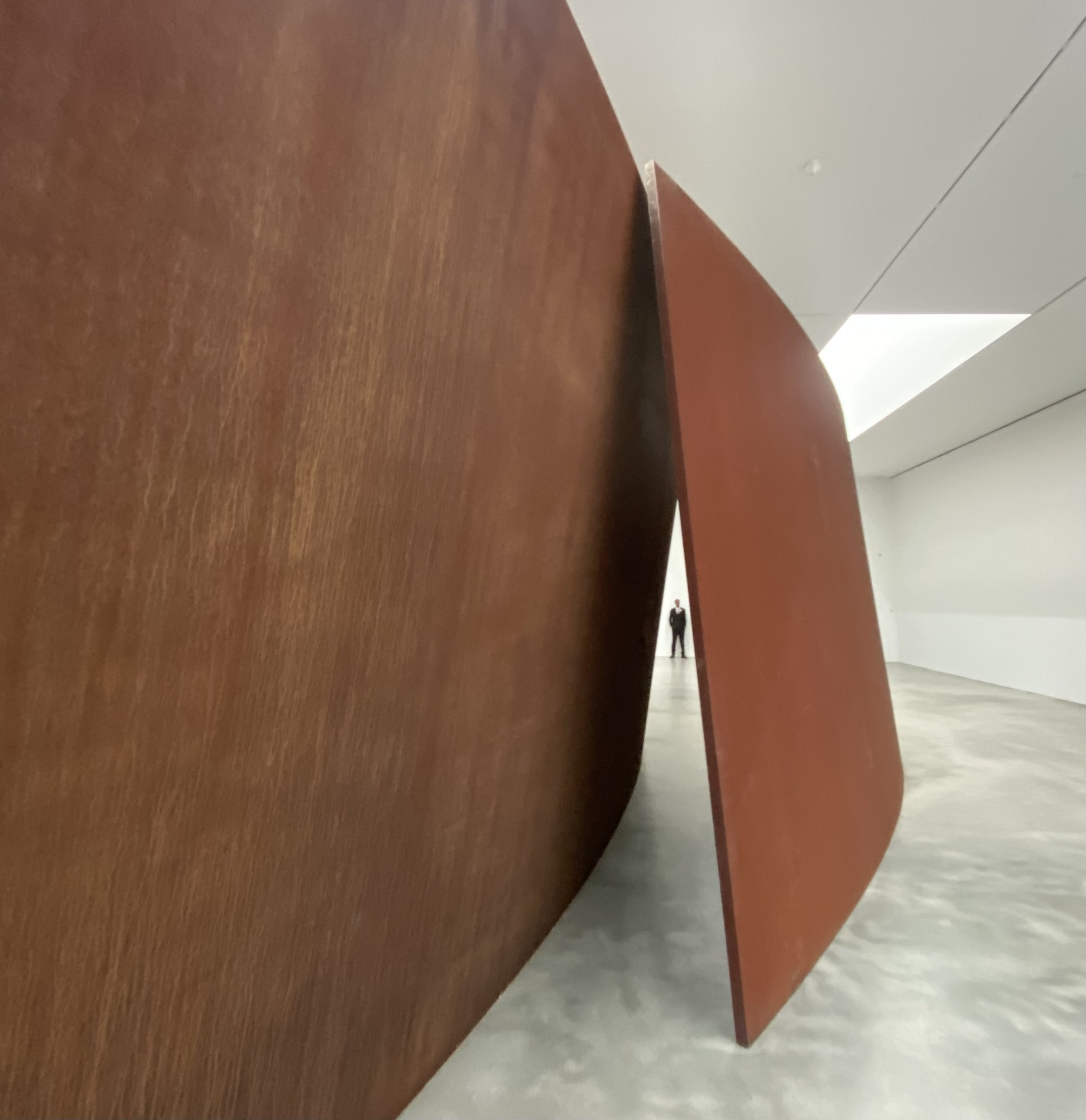
The rusted soft red of the steel surfaces, lightly touched with green, instills a sense of calm within the vastness of the built structures we move through. The depth of the warm hue, consistent across the three arcs except for one small section, conveys a sense of freshness in the fabricated material, in contrast to the dull, weathered steel commonly seen in many urban settings. Serra’s work brings steel out of its everyday industrial applications, allowing the viewer to appreciate its processing and careful crafting, its aging and quiet strength, and its physical weight.
Serra’s Running Arcs also carries significant political and legal resonance, tracing back to the controversy surrounding the 1989 destruction of his Tilted Arc (1981) sculpture in New York City. This controversy remains a classic case in the collision between artistic rights and state authority.
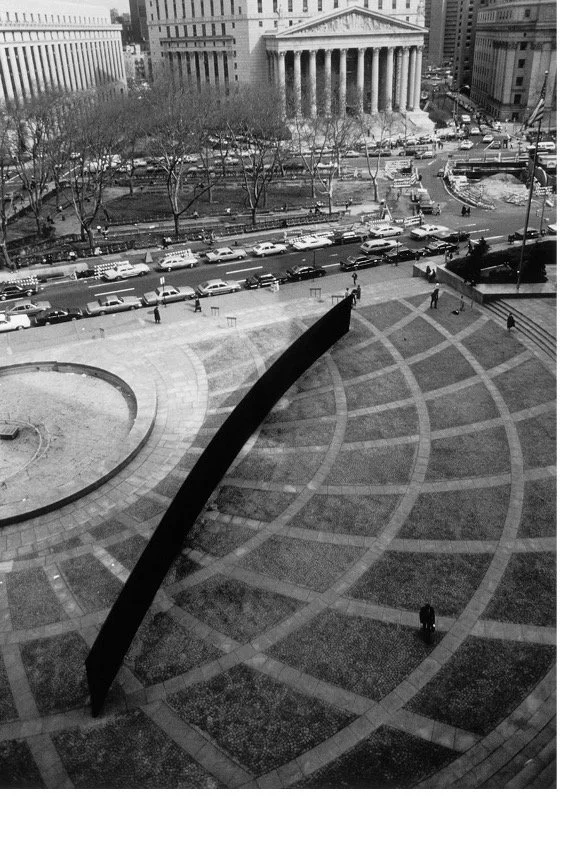
Tilted Arc, 1981. Federal Plaza, New York. Collection of U.S. General Services Administration, Washington, D.C. Destroyed by U.S. Government, March 15, 1989. Photo by Ann Chauvet.
Tilted Arc was commissioned by the General Services Administration (GSA) under the Carter Administration as part of a legally mandated public arts program and installed at Federal Plaza in New York soon after President Reagan took office. Despite a majority of support expressed at a public hearing, reinforced by an expert panel of opinion assembled for review, Reagan’s GSA chose to destroy the work as a demonstration of brute political force against the moral rights of artistic expression. Serra was outraged and sued the government. One of the top litigators of the time, Jay Topkis of Paul Weiss (who represented Serra pro bono), told him that he had no chance of succeeding. Serra sued anyway.
As Serra and his wife, Clara Weyergraf-Serra, later recalled, opponents of Tilted Arc employed inflammatory and unfounded claims, alleging that the sculpture would attract rats or serve as a terrorist “blast wall.” The campaign even escalated into public vilification and death threats.
“They took the photograph of the Vietcong being shot in the head,” Serra recalled, “wrote ‘Kill Serra’ under it, and plastered it all over downtown.” Such was the political violence that could accompany a public sculpture’s contestation.
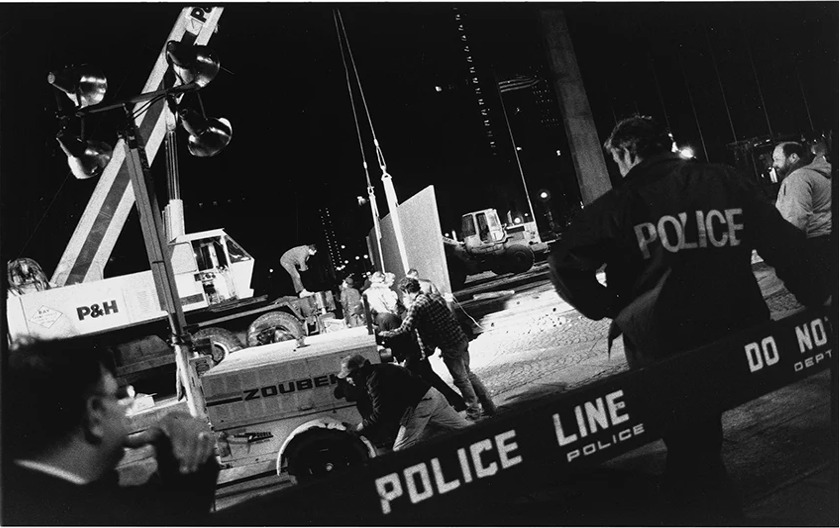
The dismantling of Tilted Arc, Federal Plaza, New York, March 15, 1989. Photo by Jennifer Kotter
Although Serra lost, a federal appeals court recognized his sculpture as deserving some First Amendment protection, even as they affirmed government authority over government property. Moreover, the defacement of Tilted Arc also underscores the political violence that might besiege a site-specific work in its encounter with a politically restless public. For the artist, the outcome was decisive. He withdrew from civic commissions and began insisting on exhaustive contractual protections for all subsequent work.
Soon after Tilted Arc’s destruction, Congress passed the Visual Artists Rights Act (VARA) in 1990, granting artists limited moral rights of attribution and integrity. It prohibited “any intentional distortion, mutilation, or other modification of [an artist’s] work which would be prejudicial to [the artist’s] honor or reputation,” unless the artist had waived this right. For decades, VARA was treated as largely symbolic, more of a gesture than a protection.
That perception shifted in 2018. In Cohen v. G&M Realty Corp., commonly known as the 5Pointz case, a developer whitewashed a celebrated graffiti series covering the outside walls of a complex in Queens. In the subsequent litigation, the court found a willful violation of VARA and awarded $6.75 million in statutory damages to the artists. The decision marked the most significant post-Serra affirmation of artists’ moral rights in U.S. law.
The lawsuits brought by Serra and 5Pointz are among many asserting artists’ rights. Artists often get into trouble for expressing disorienting perspectives that disrupt the status quo. Often, it is “good trouble,” as political activist and politician John Lewis would say. Artists, however, can stir up trouble when they criticize politics. A contemporary example is Ai Weiwei, who has provoked the authoritarian Chinese government with his politically inflected work, in cases such as the Chinese Government Tax Case (2011-2) following his detention, and the Danish Car Company Case (2017), in which he sued the Volkswagen dealership for using an image resembling his artwork for advertising. Andy Warhol has been named in major copyright law, including the Warhol Foundation v. Goldsmith. In 2023, the Supreme Court ruled 7-2 against the Andy Warhol Foundation to protect the commercial rights of Goldsmith’s original images.
The toleration of artistic expression is a measure of a politically free society. In the United States, the First Amendment is often invoked as a major safeguard of artistic expression. Still, as Serra’s unsuccessful bid to save Tilted Arc, it provides uneven protection in practice, especially when an individual artist confronts powerful corporations or governments that might employ top lawyers to draft sophisticated contracts and engage in litigation. Legal outcomes in this field are rarely predictable and often asymmetrical. Still, the law remains a critical battleground for preserving artistic freedom and artists' rights in free societies.
The controversy surrounding Tilted Arc unfolded just as the United States entered a conservative political climate following the election of Ronald Reagan, when debates over public funding, national identity, and the legitimacy of contemporary art intensified. A similar alignment of politics and cultural policy has emerged during the presidency of Donald Trump. Similar to Serra’s tension between expressive freedom and institutional power, this tension is increasing once again. In March, the American Civil Liberties Union, representing four arts organizations, filed Rhode Island Latino Arts v. National Endowment for the Arts in federal court, challenging a new funding ban by the Trump Administration against grant applicants who “promote gender ideology.” The plaintiffs allege violations of the First and Fifth Amendments as well as the Administrative Procedure Act. In September 2025, the judge hearing the case ruled that the new National Endowment for the Arts (NEA) policy regarding “gender ideology” was unconstitutional under the First Amendment. However, it is uncertain whether the Trump Administration will comply with the judge’s ruling. Hundreds of NEA grants were rescinded in 2025 due to shifting federal priorities, prompting artists and arts organizations to scramble for alternative aid. In 2025 alone, the Artistic Freedom Monitor, a platform that documents government actions that threaten artistic rights and independent cultural institutions in the United States, identified more than 58 laws and policies enacted to limit artistic freedom, as well as more than $250 million in funding cuts.
The political climate in Serra’s era and today reveals a recurring pattern. When elected political leaders turn sharply conservative, protections for artists’ rights weaken. Although Serra lost his Tilted Arc case, it established a lasting precedent for artists asserting legal claims against governmental interference. What the political and legal history surrounding Serra exposes is not a failure of aesthetic judgment. Rather, it attests to the structural dominance of institutional governmental power against individual artistic authors. Under the Copyright Act of 1976, copyright protects original works fixed in a tangible medium of expression. As of today, concepts, ideas, systems, or methods are still not copyrightable under U.S. law. Additionally, what Serra deemed “the moral rights of artists” are typically assessed post-damage. The law, not surprisingly, too often sides with governments and large corporations against artists.
Today, Running Arcs distinguishes itself not only by its formal authority as an artistic masterpiece but also by its symbolic political positioning and its implicit doubling down on the old Tilted Arc. Installed safely within a private gallery, we saw Running Arcs beyond the immediate reach of municipal politics or administrative ruling. The political and legal conditions that allow the sculpture to endure include contractual clarity, institutional insulation, and private power, which Serra learned to demand after the removal of Tilted Arc. In this sense, Running Arcs demonstrates the importance of maintaining private centers of power to protect art that speaks in critical, reflective, and even confrontational styles to the institutional forces of both government and commerce.
We imagine that Running Arcs might find a new permanent home after Serra’s passing. The divine setting of the Gagosian would be transformed: What John Updike called “Serra’s rusty slices of grandeur” would instead reach toward an open sky and carve viewers’ experiences under it. This statement piece would also express a l'art pour l'art and pro-artist stance against authoritarian winds. The picture Serra painted with the Tilted Arcs, in some way, expresses the true aspirations for greatness of the American artist, as well as a world in which individual artists' rights are respected and protected as an integral part of freedom. It would show, to adapt a phrase, that the arc of justice can yet bend toward artistic freedom.
*Chau Nguyen is a conceptual artist and art critic based in Philadelphia and New York. She is a scholar of Vietnamese art history and its complex relationship to the contemporary art market, exploring how cultural memory, migration, and artistic innovation intersect in global contexts.
**Eric Orts is a professor at the Wharton School of the University of Pennsylvania. His interests include abstract painting and modern and contemporary art.
References:
American Civil Liberties Union, “Court Cases: Rhode Island Latino Arts v. National Endowment for the Arts,” Mar. 6, 2025, https://www.aclu.org/cases/rhode-island-latino-arts-v-national-endowment-for-the-arts.
American Civil Liberties Union, “Court Rules in Favor of Artists, Free Speech, in Case Against the National Endowment for the Arts,” Sept. 19, 2025,
Artistic Freedom Initiative, “Artistic Freedom Monitor USA: 2025 Fact Sheet,” Jan 2026,
https://artisticfreedominitiative.org/research/artistic-freedom-monitor-usa-2025-fact-sheet/.
Castillo v. G&M Realty L.P., 950 F.3d 155 (2d Cir. 2020).
Aruna D’Souza, “Mamdani Appoints New York’s Next Culture Czar,” New York Times, Feb. 28, 2026, https://www.nytimes.com/2026/02/28/arts/design/mamdani-culture-czar-diya-vij.html.
Hal Foster, “Looking Back at the Destruction of Richard Serra’s Tilted Arc, 30 Years Later,” Metropolis, Mar. 14, 2019 (interview with Richard Serra and Clara Weyergraf-Serra), excerpt from Conversations About Sculpture (Yale University Press 2018), https://metropolismag.com/viewpoints/conversations-about-sculpture-excerpt-foster-serra/.
Beverly Held, “Richard Serra: Steel Plated Tanker as Madaliene,” Musée Musings, Newsletter, May 12, 2024, https://www.museemusings.com/blog/richard-serra-steel-plated-tanker-as-madeleine.
Joan Kee, Models of Integrity: Art and Law in Post-Sixties America (University of California Press, 2019).
Rhea Nayyar, “Meet the Members of Mamdani’s Arts and Culture Transition Committee,” Hyperallergic, Nov. 25, 2025, https://hyperallergic.com/meet-the-members-of-zohran-mamdani-arts-and-culture-transition-committee/.
Office of the Mayor of New York City, “Mayor Zohran Mamdani Appoints Diya Vij as Commissioner of the Department of Cultural Affairs,” Feb. 28, 2026, https://www.nyc.gov/mayors-office/news/2026/02/mayor-zohran-mamdani-appoints-diya-vij-as-commissioner-of-the-de.
Frederick Schauer, “The Politics and Incentives of First Amendment Coverage,” 56 William & Mary Law Review 1613 (2015).
David Schneider, Richard Serra interview, Bomb Magazine, Jan. 1, 1993, https://bombmagazine.org/articles/1993/01/01/richard-serra/.
Serra v. U.S. General Services Administration, 847 F.2d 1045 (2d Cir. 1988).
Roberta Smith, Richard Serra, “Who Recast Sculpture on a Massive Scale, Dies at 85,” New York Times (updated Mar. 29, 2024), https://www.nytimes.com/2024/03/26/arts/richard-serra-dead.html.
Barbara A. Spellman & Frederick Schauer, “Artists' Moral Rights and the Psychology of Ownership,” 83 Tulane Law Review 661 (2009).
John Updike, “Serra’s Triumph,” New York Review of Books, July 19, 2007, https://www.nybooks.com/articles/2007/07/19/serras-triumph/.
Visual Artists Rights Act of 1990, https://www.law.cornell.edu/uscode/text/17/106A.